The verdict
One paragraph, plain English, at the top of page one. Two scores: how AI rates you when a buyer names you, and how often you appear when they do not.
 Request a strategy call
Free AI visibility check
Our AI visibility tool asks ChatGPT, Gemini, Perplexity and Claude the questions your buyers ask, then a senior specialist reports who gets named, who gets cited, and why. Free. You keep the report.
Trusted by Australian and global organisations




















A real report
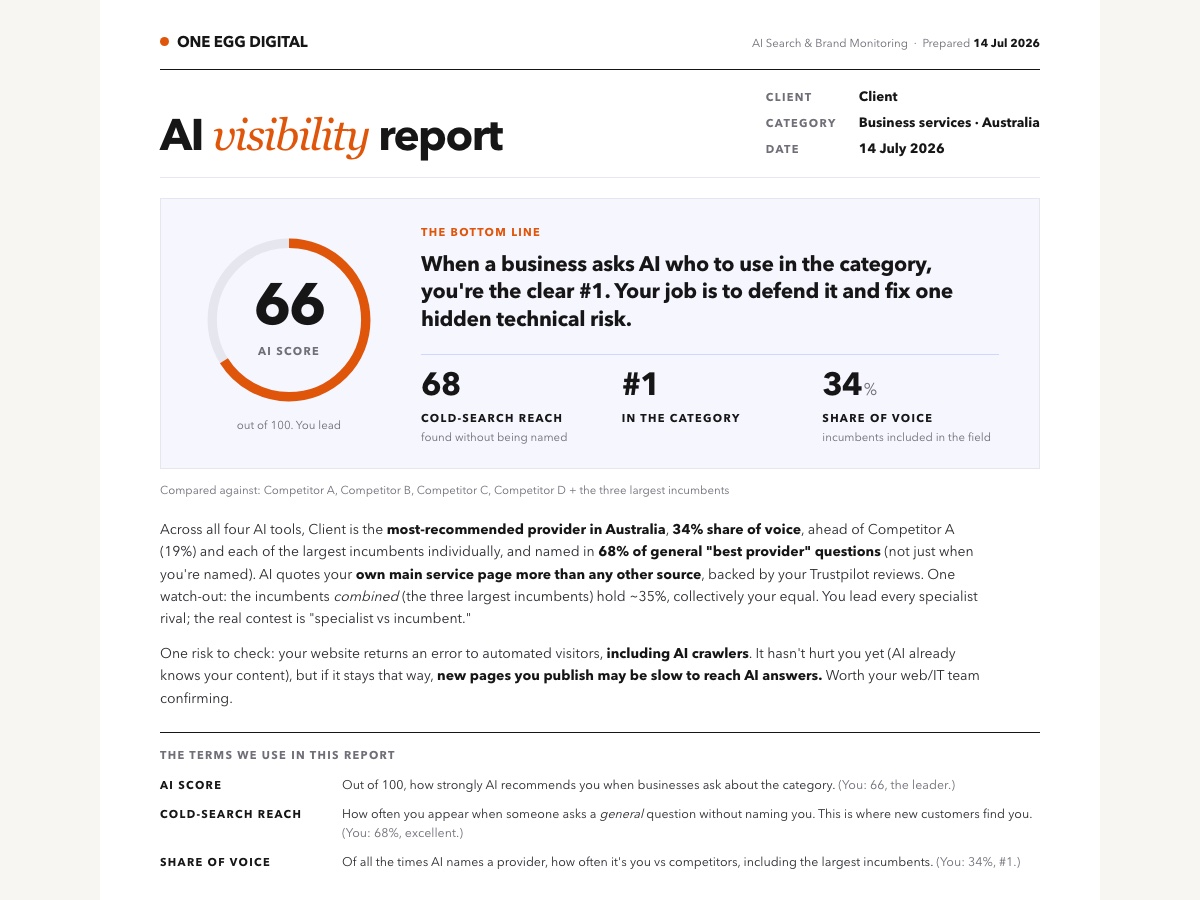
Page one of a real client report, with the client, the category and the competitors anonymised. When a buyer asks AI who to use, this client is the clear number one: 34% share of voice against four specialist rivals and the three largest incumbents, named in 68% of general "best provider" questions where no brand was mentioned, and AI quoting the client's own pages as its top source.
The report also caught something nobody had noticed. The client's website was returning an error to automated visitors, including AI crawlers. It had not hurt them yet, because the engines already knew their content, but new pages would have been slow to reach AI answers. One line in a report, one ticket for the web team.
Most first reports do not look like this. Most businesses are strong on their own name and near invisible on the general questions. Either way, you find out on page one.
What's in the report
Two cuts: a two-page executive summary for the decision maker, and the full report for whoever has to act on it.
One paragraph, plain English, at the top of page one. Two scores: how AI rates you when a buyer names you, and how often you appear when they do not.
For ChatGPT, Gemini, Perplexity and Claude: visibility score, how often you are present, where in the answer you land, how often you are named first, share of voice and sentiment.
Brand, comparison, discovery and use-case questions scored separately. Most businesses score well on their own name and badly on "best provider for..." questions. That gap is the diagnosis.
The attributes each engine attaches to you, quoted verbatim, with every claim marked accurate, outdated or wrong.
Every source the engines cited, how many times, and whether you appear on it. Directories, listicles, review sites, Reddit, competitor blogs.
The prompts you lose ranked by how often they are actually asked, and the fixes most likely to earn your first citations. Specific enough to assign on Monday.
Why the tables matter
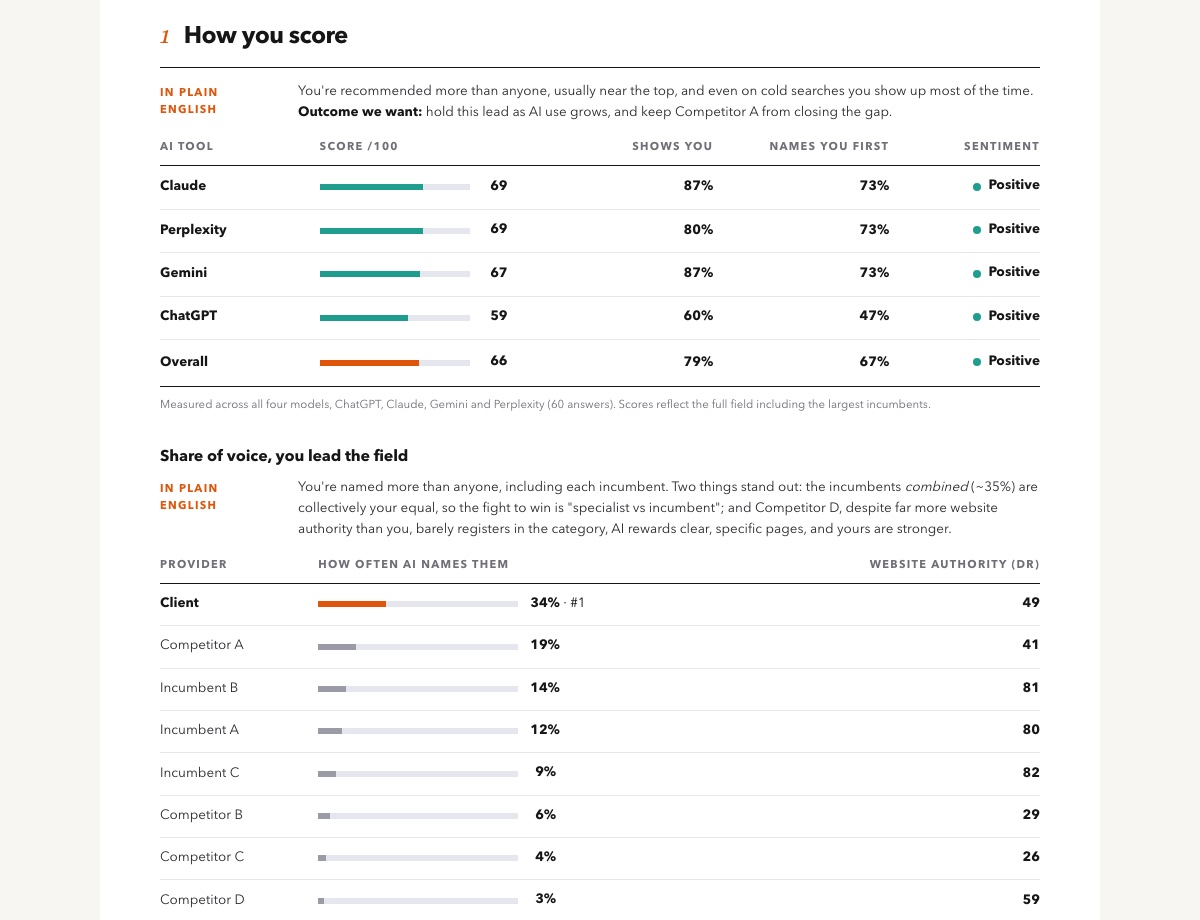
Most AI visibility scores blend everything into one number. That number is usually flattered by questions that already contain your name. We split them out. Branded questions tell you whether AI likes you. Non-branded questions tell you whether AI will ever introduce you to someone new. New clients start non-branded.
We then weight each lost prompt by how often it is asked, using AI search volume for your market. The plan is ordered by that number, so the first fix is the one worth the most, not the easiest.
Already know you have a gap? Read how we close it on the AI search optimisation page, or go to the engine guides for Google AI Overviews and ChatGPT.
How it works
No software to install and no access to grant. We only need your website, your market and your competitors.
Your website, your market and the competitors you lose to. Two minutes.
Fifteen buyer questions, agreed with you, asked of ChatGPT, Gemini, Perplexity and Claude. Sixty full answers and every source they cite, recorded.
A senior specialist scores the answers, fact-checks what AI says about you and writes the verdict. The tool collects. A person decides what matters.
Within two business days: a two-page summary and the full report. You keep both.
Thirty minutes to walk through it. No pitch deck. If there is nothing worth doing, we will say so.
Why it matters
A growing share of your prospects ask an AI assistant to compare options before they open Google. The answer names two or three providers, with reasons. If you are not one of them, you are not in the running, and no amount of ranking on page one changes that.
The engines pick their sources differently from Google's ten blue links. They favour pages that answer the question directly, third-party pages that mention you, consistent facts about your business across the web, and structured data that tells them who you are. These are fixable, but only once you know where the gaps are.
We built the tool because our own AI search work started the same way: an Australian finance company with a new product and no organic visibility, which within seven months was recommended as a top option across five AI platforms. The first step was measuring.
Engines in every report, plus Claude
Questions
Yes. There is no charge and no obligation. The tool costs us little to run, and the report is the fastest way to have a useful conversation about AI search. Most businesses have never seen how they appear in AI answers.
ChatGPT, Gemini, Perplexity and Claude, with web search on, so the answers match what a buyer sees today. Google AI Overviews can be added for specific queries on request.
The collection is. The tool asks each engine the same prompts and records the full answers and citations, so the data is consistent and can be re-run later to measure change. The reading is not. A senior specialist scores the results, fact-checks what the engines say about you and writes the verdict and the plan.
Your website address, the market you sell into and the competitors you most often lose to. If you know the questions your buyers ask before choosing a provider, send those too. If not, we will draft the prompt set and confirm it with you before running anything.
An SEO audit looks at how your site ranks in the ten blue links. This looks at whether AI engines name or cite you when someone asks a question, which sources they rely on instead, and why. The two overlap, but the gaps are usually different. Our AI search optimisation page explains the differences.
Yes. Because the prompts and engines are fixed, the same report can be re-run monthly and compared. That is how we measure progress inside an AI search programme: the baseline report is the first one you receive for free.
You keep the report. If you want help acting on it, we will quote for an AI search programme. If not, no follow-up sequence, no sales calls.
Get started
Tell us your website, your market and who you lose to. The tool runs the prompts, a senior specialist writes the report, and you have it within two business days.
Prefer to talk? 1300 490 147